Thursday, February 15, 2007
Redemption
Blessed with a journalist's working hours, my alarm was still an hour from sounding when I rolled out of bed at nine in the morning. Opening my computer to see that I had no new email and that there was no new news coming out of Lebanon, I crawled back into bed for some more shut eye.
When I got out of bed an hour later, I flicked on CNN, a common trick for helping me come to my senses. I turned it on just in time to see the broadcast's opening segmet. "Twin blasts kill a dozen north of Beirut," the caption at the bottom of the page read. Startled, I hustled through showering and getting dressed before running out the door. As I walked down the street, it seemed just perfect to me that a day like this would be cold and rainy. It wasn't that the rain was that hard, it was that the cloud cover was so thick that the city was eerily dark.
When I bustled into work minutes later, I conferred with the other journalists to get the news. In the middle of my questioning, two other reporters brushed by me towards the door. One of them was in tears because her family was from the mountain town where the bombing had occurred. Hardly saying a word, I grabbed my camera and rushed after them. We were soaked by the time we reached our car just a block away.
What was so terrible about this bombing, we all agreed in the car, was that this was really the first time since the civil war ended that terrorists had targeted civilians at random. Unlike many other terror-prone Middle Eastern countries, terrorism in Lebanon targets important politicians and journalists almost exclusively.
Our route took us about twenty minutes straight up the coastal highway. The clouds kept us from seeing much of the sea. We then made an abrupt turn off the highway and started up the tiny mountain road that would take us to our destination. Small town piled upon small town all rolled out in front of us as we tackled a seemingly endless set of switchbacks that traversed the steep mountainside. Watching the clouds wind their way through the mountains, I could not help but feel some sort of dread for having tagged along.
At last, we saw a poncho-wearing policeman up ahead on the road, diverting all cars off to the left. We drove up to him and showed our press credentials and he immediately, and almost apologetically, waved us through. We drove another fifty yards up the road and parked. As we headed up the rest of the way on foot, we began to see an assembled crowd ahead. There were too many cars, journalists, and policemen to make immediate sense of my surroundings.
As I approached, however, it all laid itself out for me in nightmarish reality. I think what initially surprised me most was, ironically, my momentary lack of shock. For a moment it seemed to me as though I had seen something like this a hundred times before. Then I realized that it was television and movies that were paving that lie, and at that moment I flinched in the understanding that this was the first real act of terrorism I had laid eyes on.
The first bus was only about twenty feet behind the police barricade. I was facing the bus head-on and the damage done to it was frightening. The windows were all either blown out or broken into shards. The back of the bus, where the bomb had been planted, was squeezed like an accordion. I was fortunate that, having arrived exactly three hours after the bombing, all the victims had been taken to hospitals and all blood had been washed away by the rain.
I turned to my left and saw the CNN reporter who had first brought the gruesome images straight from the rainy mountains into my apartment. In front of me was a barrage of policemen and several bomb sniffing dogs. Soaked to the bone with their backs to the buses, the policemen looked something between scared and helpless.
Dignitaries streamed to the site. Members of Parliament, flanked by body guards and led by aides with umbrellas, would duck under the police line and walk right up to the buses, head bowed as they prayed for a moment or two before being hustled back to their cars by concerned guards.
The second bus, about thirty meters behind the first, was even more chilling. Its roof and walls were entirely ripped off. Where they had landed, I have no idea. Soaked and burned, the brownish-orange seats sat in a mangled mess. Devistatingly, local store-keeps told us, the bomb in the second bus went off between five to ten minutes after the first one. By the time the second one went off, people had swarmed the first bus, trying to help the injured. After the second explosion, locals were too afraid to approach the buses and help people for fear of further bombs. This was truly the classic definition of terrorism.
Standing where I was, twenty feet from the first bus, I looked out left of the road into a steep drop-off between mountains. On the right side of the road was a tall wall that had been erected when the road was carved out of the mountain. The distance between the wall and the drop off must have been fifteen yards. As I stood there taking in the scene, the most devastating thing happened. A group of about a dozen ten year-old students came walking up from behind. Ushered by several teachers, they were on their way home after school had been cancelled early. Because of the limited number of roads on the mountain, the kids were forced to walk down this one.
When they arrived at the police barricade, one of the teachers conferred with the head policeman and explained the issue. The policeman looked reluctant since almost nobody, barring dignitaries, were gaining access to the site itself. But he relented. As the students, short enough to not have to duck under the police tape, started heading down the road, their teachers called to them urgently and repeatedly to face the wall. "Look at the wall," they yelled. "Don't look over here." But as ten year olds tend to, several of them stole looks at the buses which lay no more than fifteen feet away. The looks on their faces will be unforgettable to me. They were clearly bewildered and pained and even the curious ten year-olds voluntarily snapped their heads back towards the wall.
I couldn't believe that this is how these kids were growing up—walking through bomb sites on the way home from an early school closure. I could not comprehend this kind of childhood.
As I stood there contemplating all this, one of the other reporters called to me to start heading back to the car. As I turned, I realized that I had been standing right next to something large on the ground. I had never bothered to look down and see what it was. But as I turned to head back, I almost fell over the bumper of the first bus, blown well down the road by the blast. I just shook my head and put up my hood to hide from the rain. Hopeless, I thought.
As bad as things get here, as bleak and as dark as times can seem, the Lebanese have a way of shocking you with their ability to turn the page. My trip up the mountain had really shaken me pretty hard, and it was with a great deal of suspicion and sadness that I rolled out of bed this morning. Just a day after the bombings, today had all the trappings of a damning day in the history of Lebanon since hundreds of thousands of Sunnis and Christians, hurting from Tuesday's bombings, would be descending on Martyr's Square to commemorate the second anniversary of the assassination of beloved Prime Minister Rafik Hariri. In the very same square, Hezbollah has its tent city, created two and a half months ago, where it has been protesting the government. It seemed as though many ominous stars had aligned themselves to bring ruin to any semblance of peace in the country. Indeed, in the past it had taken far less than today's conditions to bring about violence.
To make matters worse in my own head, I was charged with writing the article on any casualties that came from today's rallies. I positioned myself in Martyr's Square early so as to be on hand if anyone got hurt. I periodically talked to the Red Cross who said that nothing had yet happened. In light of the previous day, I felt miserable as I stood there waiting for the fighting to break out.
But what transpired in Martyr's Square was inspiring. Hundreds of people set themselves up around the square, selling sandwiches and sodas and handing out flags and scarves and hats. On top of that, today was a family affair. Thousands of families—men, women, and children—came together in a carnival-like atmosphere to remember the leader they loved. Wearing everything from western dress to full-fledged hijabs and galabayas, they came. Some were dressed in work clothes and others in celebratory outfits. Kids played and laughed and sang. Periodically from one corner or another from the square I could hear the ring of drums as a small group of children had gotten together to do a chant.
About three and a half hours after I arrived, the speeches began. Gibran, Edde, Geagea, Jumblatt, Hariri Jr.—they all came and tried to rouse the crowd. Filled with energy, the crowd responded enthusiastically, hollering in approval, thousands of Lebanese flags fluttering.
In a time of so much despair, the Lebanese really give reason to hope. On a day where all the seeds for violence had been planted, the people rejected that in favor of celebration. Despite so much cause for a fight, the Lebanese people en masse put civil strife on hold to give Hariri the celebration he deserved. It also gives hope for the future. If there ever was a day for the fragile and tentative peace in this country to spiral out of control, this was it. After today, Lebanon looks, just maybe, like a country unwilling to enter the period of violence that looks so imminent.
The speakers throughout the day continually referred to the capital city as Beirutikum, meaning Your Beirut. Today, the people of the Lebanon really took that to heart, embracing the city as their own rather than looking like a group wanting to destroying it. For this reason, getting up in the morning tomorrow will bring a little more hope.
Tuesday, February 13, 2007
The Stage
I look out the windows behind me and the mountains to the north and east are shrouded in low, dark clouds revealing only occasional glimpses of steep slopes plunging into the sea that give Beirut so much of its allure. It is probably a good thing that the mountains are hidden for just inside of them two bombs tore through commuter buses, killing several about three hours ago.
Just down the block, Martyr’s Square is a land divided. Just south of Hariri’s great blue-domed mosque, members of Hezbollah pass the days in their camp talking, drinking tea, and playing soccer as part of their two and a half month long sit-in strike against the government. Next to them is the fence. It is a new fence that runs right into the heart of Hariri’s beloved mosque. Built just last week, this fence is a tool to insure peace tomorrow. It is funny how a tall steel wall and two rows of razor wire can be used as tools of peace.
On the other side of the wall is an empty plaza, stretching almost to the sea. In twenty-four hours time hundreds of thousands are expected to flood it to remember their great slain Prime Minister.
So the stage is set. One plaza with two sides, a Hezbollah camp filled with life, a Hariri camp empty but expectant, an ominous wall down the middle, and now, today, the emotional charge that will set the tone.
Thursday, February 08, 2007
More photos
Fire-- Six photos from Beirut
This is the first of three postings I'm doing all at once. To begin, scroll down to the post "Three Stories" and work your way up from there. I keep working on posts and then new things come up, so I get a major backlog. The two posts below this one really combine most of my stories and clear my backlog of things I want to write about.
This post is for photos since my blog has been light on photos so far. I have a bunch of others I've been trying to post of my weekend adventures, but technical difficulties are preventing me. Enjoy these for now.
Smoke rising up from burning tires in Martyr's Square in Central Beirut.

Tires on fire in Central Beirut.
Members of Hezbollah with a container of gasoline.
Bombed out buildings from the summer war with Israel in the southern suburbs of Beirut.
More rubble.
Rubble in the southern suburbs from the summer war with Israel.
First Adventures out of Beirut
The Bekka has always been number one on my list of places to go in Lebanon, and rather than wait and build up to it, I just decided to go straight away. The transport system in Lebanon is incredible. When I arrived at the bus terminal in Beirut, several men asked me where I wanted to go. I said I wanted to go to the village of Ksara in the Bekka. I was then shuttled to one of the many, many microbuses waiting at the terminal. Unlike any place I've been, there was no haggling over my business. There was order and reason to it all. I made it to Ksara, roughly an hour and a half ride, for three dollars only. To get to the Bekka Valley, which runs north to south on the eastern edge of Lebanon, we had to drive through the impressive Chouf mountains that made for really steep roads and some pretty intense snow.
By the time we got to Ksara, the snow had turned back to rain, and we were ready for the first stop on our daylong tour. We stopped in Ksara to go to the oldest and most famous winery in Lebanon, which is, surprisingly, supposed to make quite good wine. Of course, we were the only idiots to be visiting the winery on a rainy Saturday in the middle of winter at 9am, but we were excited nonetheless. A smart young Lebanese woman gave us a tour of the winery. The winery, back fifty years ago, had been owned by monks who made and sold wine, the profits form which would benefit the church. It is now owned by four private families. Our guide showed us the natural caves which are two miles in length, and because of their constant year-round temperature, are where the wine is aged. Barrels upon barrels of wine lined the corridors of the caves. Little alcoves on the right and left were used to keep wines from each year for the sake of history.
The tour concluded with a wine tasting in which our guide gave us all the information on the different wines and gave us different kinds of things, including Lebanon's national drink, Arak. When all was said and done, we went to the store in the winery and I bought a bottle of cognac, something I don't even drink, because production of it was stopped when the families bought the winery from the monks. The thought of owning fifty year old cognac made by monks in the heart of Lebanon was too much. Plus, it didn't cost a lot.
From west-central Bekka, we moved on to the south Bekka. The day before, while on assignment, I had met the mayor, named Kamal Harb, of a small city called il-Marjj. He invited me to come visit him anytime, and when I told him I was going to be in the Bekka the next day, he insisted I come by for coffee. To get down to his town, we took a taxi driven by a Palestinian who, when I asked him about his desire to return to the West Bank, got the most glazed over look in his eyes that I have ever seen. It was one of the purest moments of nostalgia I think I'll ever see. I bring it up only because at the mention of Palestine, it was startling how much he was transported to a different time and place.
We ended up staying and chatting with Kamal for almost two hours. We talked only politics, but of a scope that ranged from local to international. One thing we talked a lot about was a meeting he had just come from. He had been meeting with the director of the military in the Bekka region to express his displeasure on the previous week's events. His town, il-Marjj, is a bastion of Sunni authority in a region that is heavily, heavily Shi'a. When the Hezbollah protestors took over the country for a day two weeks ago, they also blocked the main street of his town with tires. He was furious because his town was Sunni and wanted nothing to do with these protests. His message to the military was that they had better take action if Hezbollah takes to the streets again because the alternative would be a violent uprising by the townsmen.
We chatted on and on at length over rotating cups of espressos, lattes, and teas. The trays of drinks kept coming, and I kept taking them as long as my host did. After a couple of hours, Kamal's brother, a dentist, arrived to take us on a driving tour of the town. He showed us everything from the town center to the agricultural fields. We saw farmland owned by the church, an unfinished library that was supposed to be built by the Syrians, and a factory that had been bombed out by the Israelis.
Kamal's brother then dropped us off at the Microbus hub and we caught one heading up to the town of Baalbek in north-central Bekka. Despite its major reputation, the town of Baalbek is actually quite small. It really has one major road with a side road that houses the souqs, or markets. The residential area expands modestly from this center, but it isn't much. What makes Baalbek so incredible are its expansive Roman ruins. When I entered the ruin complex, right next to the town, I saw some free standing wall structures with acres and acres of fallen columns and other giant pieces of marble and granite strewn across yard. The bits of wall still standing have varying degrees of carving and detail left on them.
The site only got really incredible towards the back. Near the end of the walk through the site I saw a giant temple on my left. Showing its age and soaked with rain, the temple now looks like a hollow remnant of its former self, but it still has the ability to amaze. Standing across from it is part of what must once have been a temple—five, or so, columns, standing lonely against the sky, supporting nothing, guarding nothing. Plus, they're on top of a major rise in the earth, so they really stand out in an unnaturally lonely way.
Drenched and tired, Steve and I headed back to Beirut to rest up for the next day. We were supposed to go skiing on Sunday, but I got an email from my friend Alex at 7:30am telling me that the snow had closed the mountain roads so we wouldn't be able to go that day. We slept in instead and got going closer to noon. Steve and I headed back to the bus station because I wanted to fulfill a serious desire I have to visit the Shebba Farms. Very briefly, the Shebba Farms are a group of farms right on the tri-border region between Syria, Lebanon, and Israel. These farms have geo-strategic benefits and are currently occupied by the Israelis. The controversy is that by UN decree, Israel is allowed to occupy parts of Syria, namely the Golan Heights, but it is unable to occupy any territory in Lebanon. Unfortunately, the ownership of the Shebba is in question. The Syrians and Lebanese say its Lebanese territory, therefore forbidden to the Israelis, while Israel claims that it's Syarian territory. Anyways, it's a really important issue in Lebanon right now and I wanted to go see it with my own two eyes.
When we got to the bus terminal, however, we learned that we'd need permission from the Lebanese army to go near the farms. Since it was Sunday, such permission was impossible to come by. Shelving my Shebba ambitions for a day, we decided to go to the port town of Sidon about an hour south of Beirut. The city itself is not much to brag about. It's a dirty collection of shops and markets in the middle of a greater residential area. The seafront is more interesting, though, lined with seafood restaurants and also with a Medieval castle that sits practically in the sea. The best parts of the city, though, are the covered markets. The old city is a collection of ratty old three story buildings. Within them, however, at ground level, are what can best be described as an endless series of tunnels, housing hundreds of small shops. From clothing to sweets to trinkets, this market had it all. Endless covered passageways that twisted and turned and forked held an immense amount of life in what otherwise would have been considered dingy and forgettable. Shopping is difficult for me because, right or wrong, I avoid giving business to any store that sells Hezbollah memorabilia. Because stores selling Nasrallah key chains or Hezbollah flags were so prevalent, my options were quite limited. I did walk out of one store, though, with a little bronze cedar tree on a wood stand that says "Lebanon" on it.
After wandering the tunnels for a while and grabbing a seaside seafood lunch, we boarded a bus and headed back to Beirut.
All the traveling this past weekend was extraordinary and has my mind wandering wildly as I begin to consider this weekend's possibilities. So stay tuned for the next installment.
Three Stories
In light of the lack of drama around here, let me tell you about the three stories I wrote this week, and the three interesting lessons I learned from writing them. I'll go in reverse chronological order.
Lesson 1: Never Underestimate a Topic
Thursday night my boss told me to attend a press conference in the morning and write an article about it. The press conference was being held to formalize the donation by the European Union of seventeen "waste management trucks" to the Lebanese government. At first, I thought this article was going to be a total snooze-fest—the kind of thing I'd do to make the bosses happy, but one with no real substance that was only getting attention because it was a slow news day.
On Friday morning, I sleepily made my way over to the Starco building in downtown where the government has many of its offices. After asking around a bit, I found the room with the press conference. To my amazement, the room was far bigger, had far more people, and had far more cameras set up than any press conference I had yet been to. Within minutes, one of the cabinet ministers and the representative from the EU strolled in. They began talking in Arabic as I began reviewing the press material, and it was then that I learned my lesson.
While waste management may not be the most fascinating topic, the story turned out to have far deeper roots. You should read the article, but I'll summarize by saying that in 1999, a commission from Europe traveled Lebanon to see how it could help Lebanon recover from the civil war, and it found that one of the most important civil elements that town leader after town leader said was lacking was the ability to manage solid waste. So, the EU gave Lebanon a multi-million dollar grant, of which an important part was set to handle waste management. Essentially, this story was, on the surface, about seventeen garbage trucks. It was, in reality, about a deep and meaningful partnership between Lebanon and a strong ally that is committed to helping Lebanon overcome setbacks from the civil war and avoid future conflict.
Lesson 2: Don't Forget about the "Lebanese Twist"
In the middle of last week, I was told to attend a press conference held by the American University of Beirut Alumni Association where they would be discussing proposed amendments to their constitution. Lesson two is not so dissimilar from the first lesson because this one too began with an assignment that did not look interesting.
After an opening word and the singing of the AUB school hymn, the press conference began with everyone looking over their copies of the new constitution. Everything was going as I'd expected. And then I began to ask questions of the people sitting next to me. With that, what I call the "Lebanese Twist" came into sharp focus. What should have been no more than a typical annual Constitutional review was actually more of a battle to stay alive. What I learned at the press conference was that the Alumni Association had always prided itself on being independent of the university because it gave the group more freedom to do as it pleased. And then, reasonably, the university decided it wanted a group to represent alumni globally, not just in Lebanon as the Alumni Association was doing. So the Alumni Association, determined to stay the only alumni group began to go ahead with a plan to globalize its operations. The university was unsatisfied with the Alumni Association's new effort and it therefore created its own group called something like the Worldwide Alumni Association. Something like that.
By the time I entered the scene—at the press conference—the Alumni Association was pushing to ratify its globalizing propositions so that it could stay relevant, prove its dominance, and eventually return to its position as the only group representing the university's alumni.
The Lebanese Twist, to me, is that no matter what the story, no matter how seemingly mundane or ordinary, there is almost always a dark political twist to it. If you search a story, top to bottom, you'll likely find a little corner of darkness in there somewhere. That's part of what gives Lebanon its appeal, but it's also what makes the country such a sad case.
Lesson 3: You Have to Deal with the War Angle All the Time
By this, I mean that in every single story I've been assigned, war is always a major player. It makes writing an article tough. You can't have a newspaper that everyday that brings war into every story, into every pore of Lebanese life. Sure, war's important, but it isn't everything. Some examples….
My first story involved covering a press conference by the head of a small Christian party who was calling for the return of all Palestinian refugees to the Palestinian Territories. If you study Lebanese history, you would know that the Palestinians played a very tragic and very destructive role during the civil war. But for the past seventeen years, since the end of the war, they have been a faction relegated to one of Lebanon's twelve refugee camps. To say they are second class citizens would be generous. They are an impoverished people with no political rights, no political rights, and no homeland. But still that press conference seeped with implication that ousting Palestinians from their territories and forcing an exodus of almost a half million people was the natural reaction to what their militia did to Lebanon during the civil war. Don't get me wrong, I'm sure that the Palestinians, as they've told me many times, would like to return to Palestine too, and the party leader at the press conference could have spun it that way, but instead he brings it back to a reaction of the civil war.
I have a few other examples, but I think I'll skip those and go right to the most potent one. Last week, I was writing a story on the VAT tax which was first implemented in 2002 in Lebanon and will now be raised to fifteen percent over the next three years. I went down to the southern suburbs, Shiite Hezbollah stronghold, to cover the impact of the tax on small business owners. I went south because it is one of the poorest places in the country, and my angle was to see just how much this tax was hurting those in greatest poverty.
I was not prepared in the least for what I was about to encounter. What I saw really knocked me back on my heels and put me into a pretty good funk for about a day. As I approached the neighborhood, I began to notice posters on each lamppost on the road's center divide. After I asked about them, my cabbie told me that on each poster was the face of one of the "martyrs" who'd died this summer in the war against Israel.
The taxi dropped me off right in the middle of the neighborhood called Haret il-Hreik, and I went to work. As I made my way down the street, stopping in stores right and left to chat with workers, I noticed that about two blocks down, the buildings just stopped on the left side of the street. While they began again a little ways later, there was more than a block with no buildings. Curious, I thought. It just seemed very out of place for the most bustling street in the southern suburbs. Since this was my first trip down there, I didn't make the mental leap I should have. Unfortunately, mental leaps were unnecessary. My eyes would take care of everything for me.
When I made my way down the street, I stopped in awe of what stood before me. Lot upon lot of mangled rubble: concrete mixed with wires mixed with lots of assorted debris. The occasional forgotten shoe gave the site its eerie humanity. Some buildings hadn't fallen, they were just gutted. This was ground zero for the summer war against Israel. I was stunned.
My interview subjects, too, seethed over the summer war. When I'd ask how the VAT tax had affected business, people would often reply sharply by saying something like, "Israel has killed my business." It took two full days of intense interviewing to get enough non-war related material to proceed with my story.
That is maybe the starkest example of the way in which war tried to push its way into my story, but it comes up again and again in almost every story I work on. This really is a country that knows war, that is prepared to fight, and that knows how to rebound from a war like no other society.
Friday, January 26, 2007
High School
I turned on the news to see what the latest was, but the reporting on BBC was too general for somebody who lives in the city. I got quickly changed and headed out to the street to get to work. I opened the front door to my building to find an almost abandoned city. There were some people walking along the streets, but there were no cars to be found. I headed on my way from Hamra, where I live, to Gemmayze, where I work, along a route that I had picked out on a map with help from my doorman. I set out with my friend Steve Walker from Groton, who is visiting Beirut for a month as part of a Middle East tour he's making, and we nervously anticipated what each turn in the road might hold.
Most of the businesses were closed, some because they were run by Shiites but most because their employees could not reach their shops. Another significant difference between this and any other day was that that the typically extraordinary view of the mountains and the sea was obscured by a dark gray haze that hung low over the city. I'd have typically taken a cab to work, but since there were none on the roads it was almost half an hour before I arrived in downtown. A part of the city that's almost unnaturally modern and clean due to Rafiq Hariri's rebuilding plan, downtown was a virtual fortress of troops, barbed wire, and tanks. We twisted and turned through downtown, passing the Prime Minister's offices and the Parliament Building before coming to the last leg of our walk.
In order to get to Rue Gouraud, where my office is, I had to cross Martyr's Sqaure, a giant oblong plaza, and a favorite spot for activist movements. Sure enough, as I entered the square, I spotted a group of about fifty or so men burning tires in the road. The amazing thing about Lebanon is that because it's such a small country, it only takes blocking a handful of roads to effectively shut down the country. Martyr's square is a confluence of important roads, and if shutting down the country was their aim, then these protestors were well placed. I passed them by quietly, drawing not more than a passing glance. I knew that hurting westerners was not their aim; plus, these men were not Hezbollah but rather members of a Hezbollah-allied Christian party called the Free Patriotic Movement (the FPM) who harbor considerably less resentment to the western countries. I could tell they were FPM because many of them were dressed in orange, the party's color. The air, as I passed these protestors, was thick with the awful smoke of burning rubber.
I made it to the office and spent the day watching the news and calling the hospitals for casualty reports. For those of you worried about me, you'll be happy to know that the staff would not send me out into the field on this day because as an intern, I was not under contract with the newspaper, and I therefore posed a higher level of liability to them. Throughout the day, I watched the western news on the television and grimaced in the knowledge of what everyone would be seeing back in the States. While what you all saw on television actually was happening here, it was not representative of the Lebanon I was witnessing. In northern Beirut, where I live and work, there were some peaceful demonstrations, like the one I saw, but by and large the city was just in a quiet waiting mode. Most of the violence was in the south of the city or in the north of the country.
I walked home without incident, picking up a couple beers on my way celebrate with Steve our first encounter with major civil strife. I went to bed that night after watching the news in which all of the many political leaders were taking to the airwaves in a flurry angry rhetoric which seemed to me to be killing more people than the day's gun battles.
I woke up the next morning, Wednesday, and wondered what the streets would be like since Hezbollah had decided against a second day of strikes. I've always been told that the greatest danger in Lebanon is that once you come, you'll never want to leave. I didn't know what to expect on Wednesday as I stepped out of the building, but I was amazed to see a city bustling defiantly with life. Suddenly I saw the other maxim I'd always heard about Lebanon fuse with the first. The second one says that the country can be besieged by war and violence one day, but that with the strength of its people, it rebounds immediately the next. I realized at that first moment I hit the street on Wednesday that so much of Lebanon's allure, so much of the reason that I'm quickly falling in love with it has to do with the resilience of its people.
Wednesday was a peaceful day in Beirut, but a hectic one in the office. I was charged with my most difficult story yet. I had to write a report on the previous day's casualties and arrests. This was challenging because the information was still coming in all day Wednesday and would continue to right up to the point I had to submit my story. The difficulty here was that I had to begin the story and continually add and edit as the details shifted. On top of that, I had sources who, for much of the day, gave me conflicting information on how many dead and wounded. So I had to continually try to widen my number of sources to achieve consensus numbers that most reflected the general thinking among the authorities. Ultimately, I ended up noting the conflicting sources in the article as well.
Then there was today. Today was the first day that made me anxious. Tuesday's violence felt somehow controlled, and I felt less at risk in the city. Today was a little more difficult. The day began with a note of optimism as I sat in the office watching the proceedings at Paris aid conference. I saw each delegation give encouraging words to Lebanon and then announce its dollar pledge. The United States and Saudi Arabia each offered generous sums, and as much as I hate to say it, I have to give the French a tip of the cap for their sizeable donation too. But then violence once again stole the headlines. Sunni-Shiite fighting broke out around the Arab University in south Beirut. In the camera shots I recognized the stadium that I had driven past many times on the airport road. I was a little rattled by this spontaneous outburst of violence because I could handle conflict that was announced days in advance, like Tuesday's, but unexpectedness of this new round really stunned me.
To make matters worse, I heard of outbursts around a university in Hamra, where I live. Furthermore, we could hear spirts of machine gun fire as we sat in our office. The whole thing made me a little uneasy.
And now I come back to the title I've assigned to this post. High School. I left the office at about 6:30, getting home around 7. When I went out to go to the internet café at 8, my doorman warned me that the government had just instated a curfew that would go into effect in half an hour. I ran down to the café to find it closed. So was the other one on my street. Considering the late hour that the curfew was announced, I saw people hustling down the street and rushing to their cars, heading home. And now here I sit, unable to leave, wondering what the coming days will hold. This amazing three day stretch began with a Lebanese snow day and ended with a Lebanese curfew. I somehow feel like I'm back in high school.
Sunday, January 14, 2007
Welcome (Officially) to Part 2: Beirut
I arrived Thursday at 4:45am after having flown British Airways through London. When I got to my apartment building, I thought I was going to have to go find a hotel for the night, but enough banging on the door persuaded the doorman in the next room to get up and let me in. My apartment in actually on the first level of the basement, but because the building is built into a hill, I am three floors up with a great view of the Mediterranean and the mountains. It's a small studio apartment with a bathroom by the entrance, a living room, and a bedroom separated from the rest of the apartment by a sort of half wall. Additionally, I have a full, nice kitchen on an enclosed balcony. Next to that, I have a great open balcony that gives good views.
I live in a neighborhood called Hamra, which is a Muslim neighborhood in West Beirut. I am only a stone's throw from the American University and from the main drag called Rue Bliss. I can't stop chuckling about the fact that even though I try to immerse myself in the culture as much as possible, at the end of the day I have to tell the taxi drivers to take me home to Rue John Kennedy.
As for what I'm doing here….. I have somehow managed to muster enough credit from Middlebury (to still graduate in four years) that I am taking this semester off. I have come to Beirut with a fulltime internship with The Daily Star newspaper. The Daily Star is the large English newspaper based in Beirut. I won't dwell on it for long since I haven't actually started working yet, but what I will tell you is that I am working for their Lebanon section, where I'll be helping out with stories, doing some copy editing, and writing my own articles. I begin work on Monday. Check out their website at www.dailystar.com.lb. If I get anything published on the website, I'll try to post the link here on the blog, but you should check out the website anyways because even by reading the headlines, you'll get an idea of what's happening in the country.
While there is a thrill to being new in a country and discovering everything for the first time, the one thing I really don't like, that I've had to do in the past couple days, is nail down the essentials. Finding the supermarket, bank, laundromat, pharmacy, etc., etc., is both necessary and tedious. I'm looking forward to finishing all that up today or tomorrow. More interesting has been the apartment search. While I like my apartment now, I need to move by the end of the month into a place that is both cheaper and closer to where I will be working. Unlike in Cairo where there are real estate agencies on every block, in Beirut you have to go door to door. Thursday was like a treasure hunt in that I'd go into a café or store and ask about apartments at which point I'd be given directions to somewhere else. By the end of the day, having wandered the length of Rue Gouraud about a dozen times, I had several contacts and decent housing possibilities.
The other thing that bears mentioning are the protests in the center of town. I'll go into more detail in my next post about why they're there, but since December 1, Hezbollah has run a sit-in protest in the center square of town until the Siniora government resigns. Because there is one big road that connects east Beirut to West Beirut, I've driven by the protests several times. What you see when you look out over them is thousands of tents of varying shapes and sizes with people wandering through them. I have not, thank goodness, seen an actual protest yet, just the tent city where the Hezbollah supporters sleep and hold their protests when called to do so. All around the camp also are hundreds of posters of Sheikh Sayyed Hassan Nasrallah, the leader of Hezbollah.
The tent city forms a sort of semi-circle around the Grand Serail, the Prime Minister's office building. The Prime Minister, Fouad Siniora, has hardly left the building since the protests began, and many of his cabinet ministers, fearing violence, have moved into the building too. Considering the proximity of the tents to the building, and considering the supposed size and volume of the protests that take place there, one can only imagine the stress felt by those holed up in the building. Between the protests and the Grand Serail, however, is an intense wall of barbed wire, tanks, and troops. Driving by it, I cannot help but get goose bumps as I watch the scene.
In general, the feel of Beirut is very different from that of Cairo. A much more liberal city, I rarely see women in veils here, and there are noisy and conspicuous bars all over the place. The relative affluence is apparent here too as evident through all the Mercedes, BMW's, and SUV's that prowl the streets. The city feels more like Paris than it does Cairo (a statement that I will permit myself to amend as I see more of the city). All in all, this is a fantastic city that seems as sexy as it does dangerous. And whether the latter contributes the former, I'm not sure yet. All I know is that I'm in for a hell of a semester, an I look forward to many more posts on the blog as my life here begins to take shape.
Friday, January 12, 2007
10 Ways You Know You're Back in the Middle East/Beirut
1) When the Che-Guevara-biography-toting Lebanese guy sitting next to you on the airplane tells the flight attendant he's "a fucking idiot" for offering wine to a veiled woman.
2) When you expect your bags to get lost en route to Beirut and when you find out they are, you know there is still order in the universe.
3) When the taxi that was supposed to be waiting for you upon your 4am arrival is nowhere to be found.
4) When the Prime Minister's office building looks more Alcatraz than the White House, with miles and miles of barbed wire and dozens of tanks and hundreds of soldiers protecting it.
5) When you begin your apartment search by asking in a restaurant for the location of a real estate agency and a waiter comes over to you and swears he's a professional real estate agent.
6) When, after seeing rain clouds on the horizon and asking somebody whether they think it will rain tonight, you get an annoyed glare and they say to you, "How should I know? Only God knows this!"
7) When you chuckle at the irony when a man in a café tells you, "You don't want to live in Hamra. That's a Muslim neighborhood. You want to live here in Gemayze because only Christians live here," which he follows up with "Alhamdulilah!" ("Thanks to Allah!").
8) When you're already able to string three languages together in the same sentence.
9) When, typical of the 'life goes on' Lebanese mentality, you get more than a half dozen "Who knows" and "I'm not even sure" comments when you ask about the Hezbollah protests that are taking place in the middle of town.
10) When you swell with pride after getting asked if you're Egyptian when you say a few quick words in Arabic.
So, yes, I am now here in Lebanon. I arrived at 4am on Thursday morning and still feel crazy with jet-lag and too tired to write a more detailed post. Tomorrow I'll put up a more thorough explanation of what I'm actually doing here as well as some initial observations from the city. After that, I'll try to do Lebanese history/current Lebanese political situation 101 so that further posts make more sense. So, bottom lines: I'm safe and sound, I'm wearing the same clothes three days running since the airport lost my bags (I'm supposed to get them back today), I'm unable to think straight due to jet lag, and I promise there'll be more soon!
Sunday, December 17, 2006
Cats, Camels, Ghosts, and More
So enjoy this post; and I'll try to finish strong in Egypt with at least one more post after this and then a third wrap-up post.
Ghosts of the Sinai
Since I've been in C
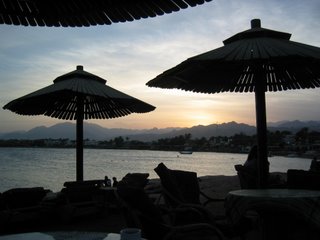
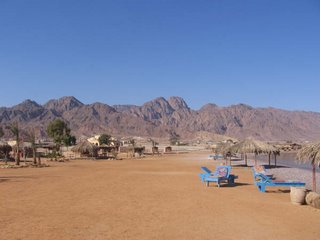
airo, I've fallen in love with the Sinai Peninsula. I've been numerous times and can't get enough. In fact, I just returned from my last trip on Sunday. Except for once, when I went with my parents to Sharm el-Sheikh, I've been going to a little strip of coastline called Ras Shaitan, literally meaning "Head of the Devil." It's a stunning place on the east coast of the peninsula, just about half an hour from Israel. It sits on the Gulf of Aqaba. Especially incredible is how at night you can see the lights from Saudi Arabia, right across the Gulf, the lights from Jordan, slightly north, and the lights from Israel, at the northern tip. You sit on these empty beaches, watching the calm surf, the jagged mountains, and the odd passing camel, you realize why this is a land worth fighting for.I first heard about the ghosts of Sinai came when we were planning a trip there a few weeks ago. I asked my friend Tom, who's working here in Cairo, if his driver Ahmed would drive us there. He told me that he usually gives Ahmed the weekend off when he goes to Sinai because Ahmed is terrified of the ghosts there. Asking around, I found out that Egyptian legend
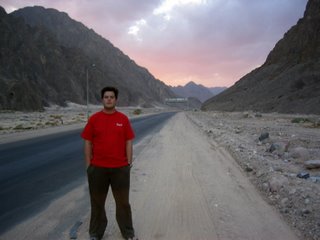
has it that so much blood has been spilt on the land there that thousands of ghosts wander the peninsula and have been known to cause car wrecks there at night. Later, asking the Bedouins at the camp about the ghosts, they confirmed the myth. I've asked various people in Cairo, too, and found this to be a popularly held belief.And then came our drive home from Ras Shaitan a few weeks ago. Driving back to Cairo involved driving straight east across the thick part of the peninsula, initially through about half an hour of coastal mountains followed by a four or five hour stretch of barren desert before reaching the tunnel under the Suez Canal.
We drove through the night, racing something of a night's sleep back in Cairo. It had been about an hour and a half since we'd seen our last town, or any form of civilization for that matter, when Tom got tired of driving and as
ked one of us to switch off with him. He pulled off the road, a precautionary but unnecessary step since we hardly ever passed any vehicles. As we all got out to switch seats, I looked across the road to see a turban-clad Bedouin man staring at us. Startled, we all rushed to hop back in the car. As I was hurrying, I said good evening to him in Arabic, to which he replied affably. As soon as all the doors to the car were shut, we raced off into the night, sure we'd pass a village over the next dune. Incredibly, we saw neither a house nor a village for another hour or two. Not only was this man hours driving from the
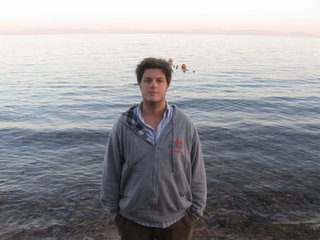
nearest shelter, he happened to be right where we pulled over our car! While that episode didn't convince me that ghosts exist on Sinai, it sure explained to me why 75 million Egyptians think they do.Photos in this section (in order of appearace): The town of Dahab at sunset; Me at sunset on the road leading into the mountains; Ras Shaitan and the mountains behind it; Me on the shores of the Gulf of Aqaba with Saudi Arabia barely perceptible in the background.
Rip-Off!
As quick as Egyptians are to negotiate a good deal for themselves, they're just as quick and true in their honesty. Hand an Egyptian a 50 pound bill instead of a 50 piastre bill, they'll quickly point out your error and save you 49 and a half pounds. They'll play hardball when it comes to negotiations, but they'll always display incredible integrity when it comes down to it. I mean it: there's a heightened level of integrity here which is truly compelling. But with every rule, there are exceptions, and two weeks ago illustrated that honesty is never a universal virtue.
Coming home from classes at the end of the day, I did as normally would by hailing a taxi and told the driver my location. About two minutes into the ride, I got the typical question, "How much." You should know that Cairo taxis do not run on meters and that the prices are all about negotiations. I told him five pounds, about right for the distance. Later, we ran into incredible traffic and the driver, who was about my age, told me that five wouldn't be enough. I agreed because it's customary to pay more for trafficky rides. But I told him I only had a five pound bill and a one hundred pound bill. He told me that this wasn't a problem, to give him the one-hundred and he'd make change. He pulled out his money, and I handed him the hundred and he gave me back forty two! When I gave him a quizzical look he shot back, "You give me fifty, I give you 100." Furious, I demanded he give me a fifty. He coyly refused holding, a fifty pound bill at arms length. When I reached for it, he held it further away still. I tried again to take the money, but he wouldn't let me have it.
Sitting here writing this story, there's no good way to end it other than to tell you that we both left that taxi a little bruised (just shoving, no punching) but triumphantly holding my fifty pound note. It was only after I'd gotten out angrily that I realized I was in the middle of a bridge over the Nile with no sidewalk! It made for an interesting walk home through all the cars, and since the traffic was going about the same speed I was walking, the driver had plenty of opportunities to smirk at me from the comfort of his car. I merely waved the fifty pound note at him and smiled broadly.
Suckered by a Glass of Tea
While I'm on the subject of getting angry, I might as well tell you another story. Last week, during a five minute break in the middle of my three hour morning traditional Arabic class, I ran to the corner, as I had done so many times before, to take money out of an ATM. I used the Bank of Alexandria machine, and inserted my card. As soon as I gave it my card, the machine flashed a "Please remove your card" display, followed immediately by "Please insert your card." Just like that, my bank card was gone. My only means of cash had disappeared. Frantically, I asked the men who were sitting nearby where the Bank of Alexandria was located. One of them looked at me in bewilderment and said, "You used that machine? Why? That's an antique!" I could only roll my eyes and set off in search of the bank.
After being sent on a wild goose chase by would-be helpful policemen and doormen, I found the bank about half an hour later. I walked into the bank and told them my problem. At first they denied that they even had an ATM machine on the street I told them. After a while of negotiating, I finally obtained that admission from them. Just as quickly they insisted that there was nothing they could do, and that the confiscation of my card had been my fault for not keeping enough money in my account (I have plenty of money in my account). At this point, I flew off the handle. These people were clearly more interested in covering their own behinds than helping me get my card back. After making enough of a stink, they told me, of course, that they'd see what they could do. They told me not to bother waiting around and that they'd call me. I left and went back to class, having missed the almost the entire second half. I was steamed and more than a little nervous.
As my afternoon class began, I warned the teacher that I might have to take a call in the middle. Because it's a one-on-one, he had no problem with this. Sure enough, one hour into the two hour class, my phone rang. I answered the phone, and the woman from the bank told me I had to be at the bank in ten minutes. I asked her if I could be there in an hour. She told me, no, that it was absolutely critical that I be at the bank in exactly ten minutes or I'd likely miss my chance at getting the card back. So I apologized to the teacher and ran from school, sprinting all the way to the bank.
I arrived flustered and out of breath and asked them for my card. Sit down, they told me, it would come soon. Annoyed I took a seat and waited. And waited. And waited. About twenty minutes later, the rage in me had come to a boil. I had cut a class an hour short to make it there when they said, and they weren't doing a thing to help me. As I had really avoided doing for five and a half months in Cairo, I started yelling. I mean really yelling. It was civil, at least, but I took full advantage of the big vocal cords I have. In the middle of my rant, the bank manager looked at me and interrupted by saying, "Tea?" I stammered. "What?" I hissed. "Tea?" he repeated. I just started yelling again, "What the hell are you offering tea to me for? I just want my damn card back!" As I kept going, he gently picked up the phone and said quietly, "Lazim shay dilwaqti." We need tea now. Ignoring him, I kept on going until he interrupted, saying, "Sugar?" I just ignored him and kept howling. "Ziada," he said into the receiver. Lots of sugar. Two minutes later, an ancient little man rounded the corner with a glass of tea and pushed it into my stomach. I was obliged to take it. He then put an arm on my shoulder and gently guided me back into my seat. Before I knew it, I was drinking delicious Egyptian tea, quiet as a mouse, content with sipping the sweet tea he'd given me. Ten minutes later, my card came to me. I never said another peep.
It's hard to do justice in describing how they defused the situation, but tea is such a typically Egyptian way of dealing with a "situation" and the hospitality was so overwhelming, and the notion was so strong that you can't accept a gift from someone else and then still have them be your enemy, that I lost the rage immediately.
Back Handed Compliment
Like I told you, we went to Sinai this past weekend. I couldn't drive out there on Wednesday, when my friends went in a private car because I had class on Thursday, so I had to buy a bus ticket. My roommate Sam and I headed out to the bus terminal a few days before we wanted to leave, walked up to the window and inquired about bus times. I told the man that I wanted a 10:15pm ticket on "yom il-guma." Friday. The man took our money and printed out our tickets, and then Sam turned to me with alarm and said, "Theo, we want Thursday. You said Friday!" So in a flurry of flustered Arabic I apologized and told him that we need tickets for a day earlier. The man behind the desk went absolutely ballistic. He told me that it was "mish mumkin." Not possible. I told him, in somewhat of a white lie, that I get my days of the weeks confused in Arabic. He shot back that I should have just spoken English to him, to which I responded somewhat heatedly that I had come to Egypt to work on my Arabic.
He continued to yell for a while before heading out of sight to talk to his supervisor. He came back five minutes later with new tickets in hand, but was not going to let us get away without chewing me out a bit more. After a while, a well-dressed man behind us said to the man in Arabic that he should give me a break because I'm not that good at Arabic. And then came the moment of glory. The man behind the desk retorted that I spoke Arabic very well and that I understood everything and that language wasn't a valid excuse because of this. Hearing this, I got a proud smile on my face, and when he turned to give us our tickets, he was more than a little flustered that the kid he'd just yelled at for five minutes was grinning so broadly. Needless to say, that feeling of accomplishment stuck with me for most of the day. The daily struggles to master the language are all worthwhile just for those brief moments of unrestrained joy. It's too bad that sometimes the great moments come in the form of a good raking over the coals.
First Rain
In case you didn't know, it almost never rains in Cairo. On top of that, the rain is limited to December through February. My hopes of seeing a Cairo rain storm before I returned home were rewarded two weeks ago. Sitting in my apartment after dark a couple weeks ago, I heard an unfamiliar pitter-patter outside. At first I didn't register what was going on, but soon enough the magnitude of what was going on outside hit me. Cairo's first rain of the season.
I didn't even bother going to the window; I just grabbed my keys and sprinted to the elevator. I was horrified that the rain might stop before I made it outside. To my great relief, I landed on the sidewalk with a decent steady rain falling from the heavens. It was just the kind of rain that's decent and steady, but not one that would necessarily make you want to cover yourself. I stood outside very comfortably with no coat and no umbrella. That was me. The scene around me, by contrast, was utter chaos. Egyptians everywhere, running, sprinting, desperately covering their heads, heading for the nearest shelter. I laughed heartily as the frenzied scene unfolded around me.
The rain lasted only half an hour, and the city took about three days to drain. The only remarkable thing about the rainstorm came after I had been outside for about ten minutes and was ready to head in. As I turned to head back to the apartment, I felt my lips begin to tingle. After a minute, the tingling rose to the level of a dull throbbing. It never got any worse than that, but it was in that moment that I realized that we were being treated to an acid rain storm. I assume that the source of the rain is the Nile which, up and down, from Aswan to Alexandria, is immensely polluted. It was then that I realized that there was probably more sense in running for cover than I had initially imagined.
Basha
Let me take you back to the first day of Ramadan. Excited by what promised to be an exciting month, I decided to try fasting for a day or two just to see what it was like. I figured that as an aspiring Middle East historian, I should try to understand the culture of Ramadan by experiencing the fasting first-hand. I resolved only to fast for a day or two since I'm not Muslim and do not feel the spiritual element that carries so many Muslims through the month.
On the first day of Ramadan, I made the critical mistake of not getting up for the pre-dawn meal. I got up at eight, went to classes at nine, and came home by two in the afternoon. What makes the fasting so difficult isn't that you can't eat. What makes it so tough is that you're forbidden to drink. It was still very hot in Cairo, and by the time I came home from classes, I was dying for a glass of water. I'm lucky that I'm not a smoker because I can only imagine how tough going without nicotine all day must be.
By about three in the afternoon, I was not a happy camper. I was sitting on the sofa not doing anything, and so my mind lingered on my hunger. With a good deal of resolve, I stood up and went down to the big supermarket in the basement of my building. I decided that I'd spend the last two hours before the break-fast buying a cooking food. I smiled to myself because I wanted to make something tasty, but in my four months in Cairo I had only mastered the art of spaghetti and tomato sauce. Several other failed cooking adventures over the months persuaded me to stick to my one dish. On the first day of Ramadan, however, I knew things would be different. I bought sausages, egg plants, tomatoes, rice (the proper cooking of which still remains elusive to me), and a variety of other foods. I headed upstairs very pleased with myself and began to prepare the meal.
It was about five minutes into my little adventure that a terrible thing happened. I was standing in front of the stove trying to light it when a giant New York City sized rat ran across my foot and under the stove. I jumped about thirty feet in the air yelling to the high heavens. I ran from the kitchen and tried to catch my breath in the living room. I didn't know what to do since I didn't want to be in the kitchen, but at the same time I had lots of food ready to be cooked and a belly that was grumbling. I'll cut the rest of the story short, except to say that it was quite an experience cooking an entire meal while standing on two dining room chairs, leaping from one to the other to move items from the refrigerator to the cutting board to the stove. And as for how the food itself turned out, let me just say that spaghetti and tomato sauce remains, to this day, the only dish I can cook.
Over the next week, the rats, yes two rats, made frequent appearance. While they stayed in the kitchen, they would run across the floor right as I, or my roommate Sam, went in there to get something. After a little while, we decided we need to do something. The problem was that because there are so many stray cats in the city, there are hardly any rats or mice to speak of. Consequently, stores don't carry mouse traps. After a week of searching, we were desperate. Finally, one night, when a big group of friends had gathered at our house, we asked for advice. After about half an hour of discussion, we decided what we needed to do: find a cat.
That night, we spent some time trying, unsuccessfully to catch a stray. The very next day, we headed to Giza, southwest of Cairo, to a pet store that my friend, Tom, knew. The pet store had only three cats. Two of them looked on the verge of dying of some terrible eye disease. The third one, however, looked healthy and strong. The assembled group discussed the cat for a while, and after a quick bit of negotiating on the price, we walked out with her.
When we got home, a raucous debate ensued as to what to name her. Finally we settled on Basha, the title given to pre-Nasser nobility and a term still used by the lower classes when addressing the more affluent (my doorman, for example, always calls me Basha).
Basha has turned out to be the perfect cat; she's sweet and playful by day, and she's a savage hunter by night. She wasn't always that way. One day, about a week after we'd bought her, Basha had followed me into the kitchen when the rat ran through. Basha took one look at that thing and ran into the corner of my bedroom where she hid for most of the night. But
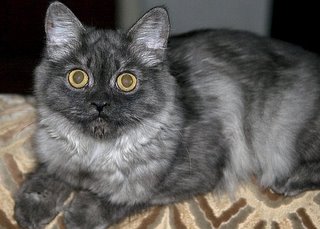
then she got her sea legs. When our handy-man was doing work on our kitchen sink a week, or so, later, he came out and announced that he'd found a dead rat right by one of the little holes that they normally get into the apartment through. So not only had Basha killed the rat, but she'd left the rat right by the hole as a message to the others. Needless to say, we have neither seen nor heard from the rats since. Since the disappearance of the rats, Basha has adopted with ease her role as a peace-time pet. She's up every morning to greet me, sitting patiently on my bed everyday as I get ready for school. While she sleeps most of her afternoons away, she comes alive at around ten at night and leaps from chair to chair in the living room until I go to bed. She proved to be a little mischievous, however, one day when I was making popcorn. I was working at my computer when I got up to go take the popcorn of the stove. When I returned, I was shocked to find that my "t" key had been nabbed! I looked all over for it: under the sofa, in her food bowl (where she likes to keep little knick-knacks she finds around the apartment), and in my bedroom. It never turned up. I've since had to make due by prying the "]" key off and putting it in the "t" spot.When I leave for the States later this week, my friend Moustafa will adopt Basha.
Three Legged Camels
I'd always heard about the camel market. Just outside of Cairo, it was supposed to be quite the spectacle. I had tried to go a couple times, but various things had intervened and prevented me from making it there. One day, my roommate Sam and I resolved to make it there no matter what the circumstances. The difficulty was that it only happened on Friday mornings and it began at six in the morning and all but finished by noon.
That morning, just a couple weeks ago, we got up around six and made it out the door twenty minutes later. Friday is a weekend day in Cairo, and there were almost no cars and no people on the road when we headed out. Because of this, we had several taxi drivers vying for our business. We ended up going with the one who spoke the best English and offered us the best price. We laughed all the
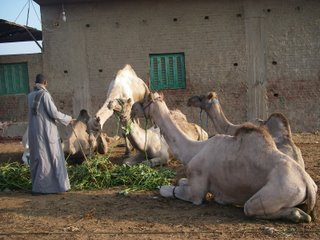
way because, not knowing we spoke Arabic, had double crossed some of the other cabbies, using his bilingualism to his advantage.The market was in the town of Ballish, just north and west of Cairo. Because of the open roads, we flew out of the city and were quickly driving through miles of farm land, punctuated periodically by squallorous villages. After about forty five minutes, we made it to Ballish. Asking for directions there, we found that the market was a good deal outside of town. It was a tricky journey out there that required a lot of turns down progressively smaller roads. But with each person we asked for directions, it became clear that we were fast approaching our destination. What let us know that we were almost there was a giant dead camel rotting by the side of the road. Before long, we rounded a corner and saw the expanse of the market ahead of us. After giving a couple pounds to mollify a man who demanded that we buy admission tickets, we began to navigate our way.
Let me describe for you the location first. On a vast expanse of dirt, two rows of ramshackle huts had been built about forty yards apart from one another creating a sort of road between them. All the business was done here. Breaks in the huts gave entrance to small side "courtyards," for lack of a better word, that also had camels.
There is one visual element that initially strikes a visitor. Most of the camels have one of their front legs folded up and tied at the knee joint. This makes it harder for the camels to run away, and astounded me as I looked out across a sea of seemingly three legged animals. The market has literally thousands of camels that have been driven north from Sudan across the desert to Cairo. Each herder has his spot on the road with between ten and fifty camels that he has either standing or sitting.
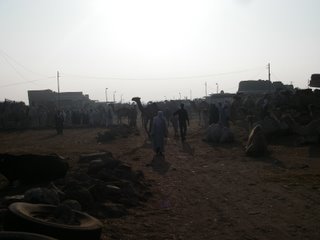
Sam and I walked down the road, surrounded on all sides by camels, trying to take it all in. One striking element of the market is the brutality with which the herders treat their animals. They all have three foot long sticks and slam their camels relentlessly with them. There's a difference between hitting a camel harder than a Westerner would like to see in order to get the camel moving from spot to another, and hitting a stationary camel repeatedly with no apparent motive.
One of the really incredible sights was witnessing the auctions. When a large enough group of people became interested in a camel, the owner would urge it away from the herd and his assistants would begin hitting it from all sides to show off its dexterity as it hobbled around. The owner would then hold court, animatedly trying to drive up the price. Understanding Arabic, it was fascinating for me to hear his tactics and listen as the price surged upwards. Twice we saw, at the conclusion of the auction, two men begin punching and shoving each other, an event that quickly escalated as men took sides and began swinging. Eventually the brawls would die out and the men would move on.
Like I mentioned, the camels are literally everywhere. At one point, Sam and I were standing on the road looking at some camels when I heard something behind me. I turned around to see an entire herd racing towards us. I had almost spotter them too late, but Sam and I ran (it was not easy to figure out where since camels were all over the place) and found refuge in a pack of lying-down camels.
Later, we found that one of the huts in the middle of the market was serving tea and shisha. The men at the market were shocked to see us come in, sit down, and order up a shisha. While we were sitting in the hut our driver appeared, as he had a couple times already, looking concerned and asking whether we were alright. He could not believe that we had wanted to come out to the market to begin with, and w
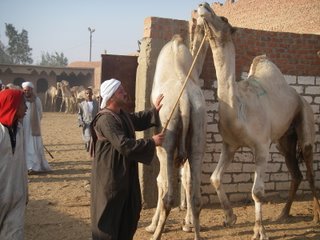
as constantly worried that the two white boys would be eaten up by this rough and tumble place. In the hut, we began talking to a little boy, probably thirteen years old, who was presumably the son of one of the herders. We asked him which were the best camels at the market, and at the end of our shisha he took us to one of the small side court yards and revealed to us a small herd of snowy white camels, well-fed and healthy looking. The owner looked like a king as he auctioned off one of his prized animals. No brawls here.After this, we headed back to the car, passing by a dog that was dragging himself by his front legs, which happened to be his only two, just to punctuate the destitution of the market. On the way home, I had an interesting language issue in one of the villages. I asked the driver to pull over at a sweet potato vendor to pick up some breakfast. The man, waiting in front of his donkey-drawn stand, looked as though he had never seen a white person before. And there's a good chance he hadn't. I walked up and asked him how he was doing and then asked for two sweet potatoes. As he had his back to me preparing the food, I tried to make conversation by asking him how his donkey was doing, "Izzay homarak?" He wheeled around with a look of fury before calming down and answering when he saw me pointing to his steed. I was a bit surprised by his initial anger and asked my friend Moustafa about it later. Moustafa doubled over in laughter, explaining to me that to ask "How's your donkey?" is an expression that essentially means, "You're an idiot." Still so much to learn….
Friday, October 13, 2006
The Class
For the past couple of months in Cairo, I've been engaged in a truly eye-opening project. I've been teaching English classes to and assisting with research on Sudanese refugees in Cairo. I came by this project through a girl I met this summer named Sarah who studies at Barnard in New York. She was working on her Arabic in Cairo this summer before heading to Amman, Jordan for her semester abroad. She introduced me Jacob, a Norwegian, who had accompanied his wife to Cairo for her new job, and he had since become deeply involved in researching the plight of the Sudanese in Cairo. The American University had given him grant money, and he has been working under the auspices of the Forced Migration Department there. He was looking specifically at, and this is what I started looking at too, the recent proliferation of Sudanese youth gangs in the city.
Before I really jump in and begin telling you about the classes I taught and about Sudanese refugees in general, let me give you a little anecdote that is really representative of the place that Sudanese refugees hold in Egyptian culture. I got in a taxi one day and began an Arabic conversation with my taxi driver. The conversation began as it always did, by the driver asking me where I'm from. I told him that I was American and he gave me a broad smile and a thumbs-up. We started talking about various world figures, and I asked him his opinion on each. He told me how much he respected Nasser and Sadat, which was pretty much a given. He told me that he supported Mubarak as well. The conversation turned to America and the driver first professed his admiration for Jimmy Carter (widely loved in Egypt because of his efforts for peace), then he began naming others like Reagan and Clinton and telling me why he liked them. Next, I brought up Bush and was astonished to hear the driver tell me of his deep respect for the current President. Figuring I had to find out what bothered this guy, I brought up my sure-fire bet: Israel. Again to my surprise, he told me that he could not harbor any ill-feelings towards Israel because the history was far too long and complicated to assign blame to just one side. Surprised, I allowed the conversation to lapse into silence. As I neared my destination, the driver asked me where I was going. I told him that I was going to teach an English class to a group of Sudanese. He only laughed. When I asked him if he liked the Sudanese, he simply shook his head and said to me "Humma ghabi awwi." "They're so stupid."
So it was in this kind of atmosphere that I began my classes.
Now a quick word about the Sudanese. Coming from the States, it's hard to imagine that Cairo would be an aspiration for anybody, but for those caught in the crossfire of Sudan's north-south civil war, this city is just that: salvation. The civil war, which ended only last year, was an ethnic struggle between the northern Arab populations and the blacks in the south. Please note, this is not the same as the conflict in Darfur which, due to the power imbalance, is not a war but a genocide. Many from Sudan's black population in the south have managed to escape to Cairo and have overwhelmed a city that is already poor and lacking in jobs. As a result, the government of Egypt has done a mediocre job, at best, at handling the influx of Sudanese. All the refugees fall into one of three legal categories. If they are blue-card holders, then they are legal permanent refugees. Yellow-card holders have been granted temporary refugee status, a legal limbo. The majority of the refugees, however, are unregistered.
While the older Sudanese associate with their tribes, many from the younger population have shed those old affiliations in Cairo. Instead, the last year or year and a half have seen the formation and expansion of gangs which provide a sense of safety through communal identity and a social network that insures nobody goes hungry or homeless. Jacob, the man through whom I was teaching a researching, was looking specifically at two rival gangs, the Outlaws and the Lost Boys, in the hopes that through a better understanding of these gangs, there might be an opportunity to replace these gangs with other frameworks that would provide the same support for these kids that the gangs currently do. What is so alarming about these gangs, Jacob told me, was how when they first formed, they used to fight with kicks and punches. He said that the fighting had progressed and that the gangs had started using sticks with which to beat each other. Just in the last couple of months, though, the gangs had begun to get their hands on swords and this had resulted in serious injuries among various members.
Let me explain the role that the English classes play. They serve, essentially, two purposes. First, by bringing the gangs into the controlled environment of the classroom, they make for good research topics. Through conversations before and after class and through various writing and speaking exercises in class, it is possible to get a pretty good read on them. The second reason for the classes shows how this is a perfect example of service-learning, a concept that I was deeply involved with at Middlebury. The researchers, headed by Jacob, ask for a lot from the refugees. Even though the project seeks to improve the conditions of these displaced people, it asks from them a lot, it asks for them to open up and trust these outsiders with their inner-most workings. In a country of tremendous hostility, that sacrifice is more excruciating than one might imagine. In return, we offer these English classes as a hope for a better future. The bottom line is that the English classes provide a portal through which to do research, but they also provide a serious service to the refugees.
There's one more important point to make. Because of the influx of refugees, the Egyptian government has a near zero-tolerance policy towards them. This means that if the refugees are arrested for any reason, including inter-gang violence, they are sent back to the Sudan. Here's the catch, though. These southern Sudanese are sent to Sudan's capital, Khartoum, which is in the north-central part of the country. Essentially, these southerners are sent to the northern capital, the enemy capital from the civil war. There they are treated as hostiles and taken into custody, where they are likely tortured and killed. It would be as if we arrested a Sunni Iraqi and handed him over to local militia authorities in a Shiite region of Iraq. What's more, it doesn't take a lot here for the authorities to arrest Sudanese. They'll look for any reason to scoop them up and get them out of the country. The point is, keeping your nose clean as a refugee is no guarantee of safety. But if these refugees can learn English to a level of decent proficiency, then they stand a good chance of being selected in the government's relocation project, through which they will have the opportunity to start a new life in a more free English-speaking country like the U.S. or Australia.
It was with these stakes, with these people straddling the line between a painful demise in a dirty Khartoum prison and a new life in America, that I entered that classroom for the first time.
I was teaching to members of the Dinka tribe, one of southern Sudan's largest, at the their tribal house, the Twic (pronounced Tweech) House in the lower-middle class neighborhood of Abasiyya. Not everyone in the class was a gang member. Some were older, maybe late twenties or thirty, and worked menial jobs around Cairo. Many in the class, though, belonged to the Lost Boys gang, and they were easily identifiable by their Tupac shirts, football jerseys, sideways hats, and occasional smell of beer. Jacob had decided to include some non-gang members to act as leaders in the class. Either way, either by blood or by affiliation, they all belonged to the Dinka tribe. Going to the Twic House is really the one place I've been in Cairo where I really turn heads. I'd always take a taxi as close as I could and would end up walking the last few blocks down a tiny road with closed down store fronts, a few shisha cafes, and a handful of auto-shops. Walking down this street, I'd see every eye lift because they were just that un-used to seeing white people in that part of town. The Twic House is a massively rundown apartment on the second floor of a crumbling townhouse. I would always walk in, at first with a co-teacher and later by myself, to a front room packed with people watching whatever junk television they could find. I'd then be ushered into the office where I'd sit with the directors of the house, chatting and drinking tea for a few minutes before heading into the classroom.
I'd always teach in one of three classrooms, all about the same size, while the other two were always filled with dozens of Sudanese huddled around a game of backgammon or poker. When I began my first class, the director followed me in and gave a prayer of thanks for my presence in the class and then left. And for the first time, I was alone, facing a class of expectant students. I also noticed that they were all standing, and they didn't sit even when I started teaching. I had to implore them several times to take a seat so that I could proceed. I would come to learn that this was a sign of respect that they would afford me every time I walked into the classroom. Also, they all called me "teacher" because after weeks of trying to say "Theo," they resigned themselves and never tried again.
The class was about twenty-five students and met twice a week from 7:00pm to 9:00pm. The range of English ability was pretty substantial, so it was a challenge to meet everybody's needs. I taught from two text-books and I would plan lessons meticulously beforehand. One of the most popular exercises was doing error sentences, in which I'd write something on the board like, "The students is doing his homework," and I'd ask them to find the error. The first few classes proved to be the most difficult because people weren't comfortable participating, but after a couple weeks, a sentence like the one above would cause an eruption of debate and conversation as several theories would swirl around the class. It was typical that after a minute or two's discussion, two possibilities would be posed to me. Usually, one would be the correct answer (remove the s from "students") and the other would be some far-flung idea, like re-ordering the sentence strangely. It's amazing to me how predictably lessons like this would play out. It was always easier for me to explain why the one answer was right rather than making them understand why their other ideas didn't work. But I made do.
Other lessons included simple reading comprehension, two-man conversations in which they had to use new vocabulary, listening to songs and understanding the lyrics, and dictation to work on their spelling. In the first class I taught, I brought in a Beatles song with the lyrics printed up. They loved so much listening to the song and figuring out its lyrics that from then on various members of the class would come up to me an beg, "Teacher, teacher, can we please listen to more Boogies songs?" After explaining for the hundredth time that the group was actually the Beatles, I gave up with amused frustration.
The first few classes were especially nice because I got to teach with my friend Sarah before she left for Amman. She was great because she spoke much clearer than I did. I'd ask her to do the difficult grammatical concepts because she was more measured and more comprehensible. Once she left, understanding that I spoke too quickly, I asked the students to just raise their hands if they couldn't understand me. Always, when I'd be discussing grammar, there would come a point when I realized that they were close to understanding. Predictably, I'd get excited and start speeding up and speaking louder, words would tumble out on top of one another, and then I'd see that first modest hand start to rise, followed by about a half dozen more. I'd have to stop, apologize, regroup, and try again.
These students were some of the most devout Christians I've ever met. When asked to form sentences, they would typically include prayer or church in their writing. After a lesson about direction, I asked them for homework to write out directions from one place to another. Only a small handful had something other than the church as their destination. One of the most amazing things about teaching is that periodically, probably five or six times in total, a different member of the class would raise his hand at the beginning, stand up, and talk about how my presence in the classroom was a gift from God, and that it was a sign of peace and of brighter days ahead for them. Imagine all of that coming from a guy who has Tupac on his shirt, a hat pulled down so low, you can't even see his eyes, and is a member of a violent gang. In the States, he's known as a dangerous punk, but add religion and he becomes a Christian struggling for survival and to stay on God's path.
Aside from various details of gang life, all of which I've passed along to Jacob for his consideration and inclusion into his reports, I got to understand the struggle that these gang members face between God and survival, two elements which are often contradictory in this city. The right path versus the necessary path. Conversations with the gang members reveal that this struggle is constantly simmering just below the surface.
To conclude, I want to tell you about one of my days teaching. This experience was one of those hauntingly inspiring events that I know will stick with me for a long time. I began my usual Thursday class at 7:00pm, going through all the usual types of lessons. We had begun a lesson on movie vocabulary (comedy, thriller, tragedy, laugh cry, exciting, etc.). I knew that movie vocabulary wasn't the most important thing to them, so I tried to steer away from that and teach them how each word was relevant in other ways, independent of film.
Because of the intense heat, I always began my classes with the lights off. By about 7:30 that night, it was getting dark, so as usual I walked over to the switch and flipped it. No lights. I tried again and again without success. I told my class I'd be right back and left to find the director. After asking him about the lights, he explained to me that they hadn't been able to pay their bill quite yet and that while I'd have lights by the next time I returned, tonight I was out of luck. I went back into the classroom and explained this to my class. The problem, too, was that because we were on a very dark street, we wouldn't be helped at all by light from there. And so I suggested to the class the next logical step. I said to them that we should leave it here for the night and pick up where we left off next week. I started gathering my things to leave while all the students huddled in intense discussion. Then, one of the better English speakers stood up and said to me, "Teacher. We need you here tonight to teach us. We need to learn English and we need you here by the grace of God." I considered this for a moment and saw that it had to be done. The desperation with which these people needed to learn English was too much to turn my back on. And so I closed the notebook on my meticulously planned lesson, put the chalk away since they would not be able to see the board, and began to teach to them as they faded into total darkness. Their skin was so dark that I literally could not see them, but for a couple who, by virtue of sitting next to the window, were illuminated in profile. And so that night, I taught for an hour and a half to a classroom of ghosts, people I could not see, but whose energy I could certainly feel. I made them act movie parts, discuss the meaning of science-fiction, listen to my sentences and find the errors in my grammar. They rose to the challenge, participating eagerly, while always deferring to the other invisible figures.
As the class came to a close, one of the voices from the left side of the classroom rose with a question. "Teacher, what is tragedy?" He had remembered it from our vocabulary list from before it got too dark. I had purposely omitted any of the heavier words from our discussion because I had figured that levity was the best way to make it through a class without lights. I began to explain to the class what it meant, but it then occurred to me that displaced from their homeland, sitting in a falling-down building in a dirt poor neighborhood, learning English out of the sheer desperation that stemming from the need for survival, these kids were living a tragedy. I didn't tell them that, though. When I finished describing tragedy, I suppose I hadn't done a very good job because one of them asked me about the difference between a tragedy and a drama, one of our earlier vocabulary words. Realizing I didn't really know the difference, I told them that a tragedy is a drama in which everyone dies. Then I understood that I was standing there in front of these students in the modest hope that I could play some small role in insuring that when all was said and done their story could be recorded in the books of history as a drama, not a tragedy.
Thursday, October 12, 2006
News
About a month ago, my computer decided that it couldn't handle the culture shock of Egypt and had a total meltdown. When I tried to turn it on it sounded as though some small animal was loose inside and the screen wouldn't even pretend to be making an effort. So about one month of back and forth with the computer company has left the computer back in my hands with a whole new hard drive and all my old files deleted. I've saved my old hard drive in the hopes that some American computer geek can do what several Egyptian computer geeks were unable to do. While my computer was on the fritz I never managed to post from the over-priced, smoky, and incredibly slow internet cafes around. Now I'm back and I'm determined to post several times a week for my last two and a half months in Cairo.
But enough about computers….
Let me give you a quick news update, although I'll be short on details because many of these tidbits I'll flesh out over the next few weeks into full fledge posts.
Just over a month ago, I moved apartments. I used to live in the neighborhood of Dokki on the west bank of the Nile but found out that my apartment, while dirt-cheap by U.S. standards, was actually costing me far more than an apartment should. My friend Moustafa helped me look for a new place and I lucked out in renting an apartment in the neighborhood of Zamalek. Ironically, Zamalek, an island in the middle of the Nile, is one of the swankiest and richest neighborhoods in Cairo, but my apartment here is costing me an arm and a leg less than my old one in Dokki.
I'm in my fourth one-month long semester at Kalimat. As ever, I'm taking a traditional Arabic class in the morning and a colloquial class in the afternoon. The traditional classes go up by half-levels, so I'm currently in 4.5, in which we read lots of newspaper articles and the most basic of Naguib Mahfouz stories. Colloquial classes go up by whole levels, and I had to skip the fourth level because I was the only one to sign up for it, so now I'm in the fifth level which mainly consists of advanced grammatical topics and strangely basic odds-and-ends vocabulary, the type that never found a place in the lower levels like animals and body-parts.
It's Ramadan here now; we're two weeks into it and have about two weeks to go. I have a long post on this forthcoming, but I'll tell you now that it's been a fascinating time that, while tedious, has been an incredible insight into many aspects of the Egyptian persona and the Islamic culture.
Finally, I've managed to add one more Egyptian trip to my name since I last posted. A couple of weeks ago, a few friends of mine and I ventured to the Sinai peninsula for a beach weekend. Needless to say, the adventure of the whole thing deserves a whole post, one I hope to get up by next week. More on travel…. The parents are on their way to Cairo in fewer than two weeks and Sharm al-Sheik, Aswan, and Luxor are on the travel list. More on that when it happens.
So that's all for now. Please check back soon!


